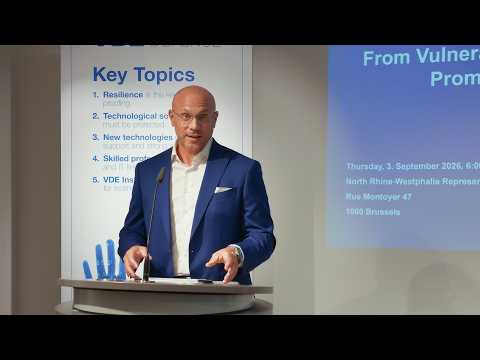
Titel photo VDE EUREL EFTS 2026
EUREL/VDE
2026-09-21 TOP

EFTS 2026

We. Network. Together. Europe. Security. Defense. Resilience. Young - Technological - Cross-Border.

Kontakt
EUREL Secretary General
Downloads + Links

Europe today faces a multitude of new challenges. Geopolitical tensions, attacks on critical infrastructure, growing cyber threats, technological dependencies, as well as forms of hybrid warfare and influence operations originating from the Russian sphere of influence, make it clear that security extends far beyond the military sphere. At the same time, modern societies and their technical systems are more closely interconnected than ever before, meaning that vulnerabilities can have a faster and more far-reaching impact.

Against this backdrop, the European Future Technology Summit (EFTS) 2026, organised by VDE and EUREL (the European umbrella organisation for engineers in electrical engineering, electronics and information technology), focused on the theme of resilience.

For years, the VDE/EUREL EFTS has provided a European platform for dialogue between politics, industry, science, engineering and security organisations. The focus in 2026 was on how Europe can strengthen its societal and technological resilience in order to identify threats at an early stage, manage crises effectively and remain capable of acting even under increasingly uncertain conditions.

In this context, resilience means not only protecting critical infrastructure and digital systems, but also strengthening trust, cooperation and the capacity for innovation. Only by acting together can Europe ensure long-term security, stability and prosperity, and strengthen its technological sovereignty and competitiveness.

THE RESILIENCE CODE: From Vulnerability to Resilience - How Technology Can Promote Security and Defense in Europe

The European Future Technology Summit (EFTS) 2026 brought together engineers, researchers, policymakers, industry representatives, operators of critical infrastructure, and military and defence experts from across Europe to discuss one of the most pressing strategic challenges of our time: how to strengthen resilience in an increasingly volatile, interconnected, and competitive world.

Under the title “THE RESILIENCE CODE: From Vulnerability to Resilience – How Technology Can Promote Security and Defence in Europe”, EFTS 2026 examined security from a much broader perspective than traditional defence policy alone. The discussions highlighted that Europe’s future security depends not only on military capabilities, but equally on technological sovereignty, resilient critical infrastructure, secure supply chains, trustworthy democratic institutions, and an informed and empowered society.

Over the course of two workshop days and the VDE Summer Reception in Brussels, participants explored how resilience can be strengthened at societal, technological, industrial, and political levels. Contributions ranged from military assessments and perspectives on European defence policy to energy security, communications infrastructure, artificial intelligence, and mobile communications technologies, as well as experiences and lessons learned from Ukraine.

A central theme of EFTS was the recognition that resilience must become a fundamental design principle. Europe can no longer assume that disruptions and crises can always be prevented. Instead, systems must be designed to anticipate shocks, absorb disruption, adapt under pressure, and recover rapidly when challenged.

The Summit, organised by VDE Policy, VDE Defence, and EUREL, concluded that resilience has become a cornerstone of European sovereignty, democratic stability, and economic competitiveness. Engineers, scientists, and technology organisations therefore have a pivotal role to play in shaping a secure and resilient European future.

Strategic context: Why resilience in the EFTS 2026?

The guiding theme of the European Future Technology Summit 2026 emerged from the growing recognition that Europe has entered a fundamentally different strategic environment from that which shaped the three decades following the end of the Cold War. The concept behind EFTS 2026 was based on the observation that resilience has evolved from a technical term into a societal, economic, and geopolitical necessity. Policymakers, operators of critical infrastructure, engineers, and security experts across Europe are increasingly confronted with a threat landscape in which security can no longer be understood solely in military terms.

Russia’s war against Ukraine, attacks on critical infrastructure, growing cyber threats, technological dependencies, and the increasing use of hybrid tactics originating from Russia’s sphere of influence have demonstrated that vulnerabilities extend far beyond traditional battlefields. Modern societies are challenged by cyber-attacks, disinformation, economic coercion, the manipulation of public discourse, and the exploitation of technological dependencies.

A central assumption underpinning the design of EFTS 2026 was therefore that societal resilience and technological resilience cannot be considered in isolation.

Democratic societies ultimately rely on trust: trust in institutions, trust in information, trust in critical infrastructure, and trust in the ability of public authorities to act effectively. When this trust is systematically undermined, the stability of society itself becomes vulnerable. Hybrid warfare is specifically designed to achieve this objective, targeting not primarily territory, but rather social cohesion, public confidence, and societal security.

The concept paper developed for EFTS 2026 therefore started from the premise that resilience begins with awareness. Societies that fail to recognise emerging threats at an early stage risk responding only after significant damage has already occurred. This challenge is compounded by the fact that modern threats often develop gradually and deliberately remain below the threshold of open conflict.

However, the strategic considerations underpinning EFTS 2026 extended beyond societal issues to encompass technological systems as well. The increasing interconnectedness of modern infrastructure means that disruptions in one domain can rapidly affect many others. Energy systems, communications networks, transport infrastructure, digital services, and industrial supply chains are now closely interwoven. As a result, security, reliability, sustainability, cyber security, and operational robustness can no longer be viewed as separate considerations.

Europe at a turning point

The strategic considerations underpinning EFTS 2026 were further shaped by the growing perception that Europe stands at a historic turning point. For many years, economic interdependence, globalisation, and technological cooperation were regarded as stabilising forces. Recent developments, however, have called these assumptions into question. Critical infrastructures have increasingly become targets for both state and non-state actors. Supply chains have evolved into strategic assets. Technological dependencies are no longer viewed solely through an economic lens, but increasingly as matters of security and sovereignty. The conception of EFTS 2026 was therefore founded on the conviction that Europe must strengthen its technological and societal resilience if it is to preserve its political capacity to act, democratic stability, and economic competitiveness.

Against this backdrop, EFTS 2026 was structured around four guiding questions:

  1. How can Europe transform technological vulnerability into resilience?
  2. How can technological sovereignty be strengthened?
  3. Which technologies will shape Europe’s future security and defence capabilities?
  4. What measures must be taken today to safeguard Europe’s capacity to act tomorrow?

The Summit’s workshops and the keynote speeches delivered during the VDE Summer Reception explored these questions from a variety of perspectives, ranging from security and defence policy to energy infrastructure and telecommunications, as well as industrial innovation and the societal and individual resilience of every citizen.

European politics up close: a visit to the European Commission and a discussion at the European Parliament

Visit to the European Commission: How Europe Shapes Policy and Finances the Future

Prior to the official workshop programme of EFTS, participants visited the European Commission to gain insights into the functioning of the European Union and its financial priorities. The visit focused on the role of the European Commission as the EU’s executive body, its responsibilities in drafting legislative proposals, and its function in implementing and monitoring European policies.

Participants also received an overview of how the European Union is financed and how the EU budget is developed. Particular attention was devoted to discussing the European Union’s future investment priorities. The Commission representative explained that, over the coming years, Europe intends to increase investment in research and innovation, digitalisation, artificial intelligence, energy and communications infrastructure, technological sovereignty, as well as security and defence capabilities. The objective is to strengthen Europe’s competitiveness, reduce strategic dependencies, and enhance the resilience of both the economy and society.

For the participants, the visit provided valuable insights into the political and financial framework conditions that significantly influence Europe’s technological development. It also became clear that innovation, research, and industrial competitiveness are closely linked to the strategic priorities and investment decisions of the European Union.

The visit therefore provided an ideal introduction to the subsequent EFTS discussions on resilience, technological sovereignty, and Europe’s capacity to shape its future.

Meeting with MEP Hildegard Bentele: Raw Materials Security as a Key to European Resilience

The young participants of EFTS were offered a political deep dive during a special exchange at the European Parliament. In a meeting with Member of the European Parliament Hildegard Bentele (European People’s Party, EPP), the early-career engineers discussed current challenges facing European technology, industrial, and security policy. The conversation focused on technological sovereignty, security of supply, competitiveness, and Europe’s ability to remain resilient and capable of action in an increasingly geopolitically driven world.

Hildegard Bentele provided participants with insights into her work as a Member of the European Parliament and explained how European legislation is developed, as well as the role of Parliament in shaping Europe’s economic, industrial, and technology policy framework. During an open question-and-answer session, the young participants took the opportunity to raise questions on the European Union’s current challenges, the role of technology in Europe’s future, and both the opportunities and challenges associated with European industrial policy. The discussion evolved into an intensive exchange on the importance of innovation, research, industrial value creation, and Europe’s strategic autonomy.

A particular focus of the discussion was Europe’s supply of critical raw materials. Bentele outlined the significance of the Critical Raw Materials Act and its role in reducing strategic dependencies. Critical raw materials, she explained, form the foundation of numerous key technologies and are therefore indispensable to Europe’s economic competitiveness, the green transition, and the continent’s security and defence capabilities.

For the EFTS participants, Hildegard Bentele also presented a nuanced picture of Europe’s innovation landscape. While Europe possesses outstanding strengths in research and innovation, it continues to face the challenge of translating scientific excellence more rapidly into market-ready products, industrial applications, and globally successful business models. This ability to scale innovation, she argued, will be crucial to Europe’s technological sovereignty in the years ahead.

As part of the meeting, Bentele also recorded a video message for the participants of EFTS. In her remarks, she emphasised the strategic importance of critical raw materials for Europe’s resilience and highlighted the need to convert research and innovation more effectively into economic success:

“If Europe wishes to strengthen its resilience and technological sovereignty, it must address the security of its raw materials supply. With the Critical Raw Materials Act, we have already made important progress in this area: we are strengthening domestic mining, reducing import dependencies, and diversifying our sources of supply. This represents a major step forward. Without critical raw materials, there can be no competitive defence industry, no semiconductors, no batteries, and no efficient electric motors. We have reached an important milestone. At the same time, significant work remains to be done. Europe excels in research and innovation, yet we often struggle with the final step: scaling innovations and transforming them into successful business models. This is precisely where our focus must lie during the next legislative term and within the next European budget.”

The meeting with Hildegard Bentele provided a valuable opportunity to gain first-hand insights into European policymaking even before the official start of the Summit and to discuss key questions concerning Europe’s technological and industrial future with a decision-maker directly involved in the legislative process. Many of the themes raised during the discussion subsequently emerged as recurring topics throughout EFTS, particularly in debates on technological sovereignty, industrial resilience, and the future of Europe’s key technologies.

Let’s get started – Workshop Day 1: Security, Innovation and Resilience of Critical Infrastructure

WORKSHOP #1 An outstanding expert provided the participants with an introduction to Europe’s overall security situation and the threats posed by other powers: Lieutenant General Wolfgang Wien, German Military Representative to the NATO and EU Military Committee. In his opening workshop of EFTS 2026, entitled “From the War in Ukraine to Hybrid Threats: What Europe Must Learn to Strengthen Its Security”, the former Vice-President of the German Federal Intelligence Service (BND) outlined the profound changes taking place within Europe’s security architecture and drew key lessons from Russia’s war against Ukraine.

He emphasised that Europe today faces a broad spectrum of threats that extend far beyond conventional military conflict. In particular, Lieutenant General Wien highlighted the growing significance of hybrid warfare. Alongside military means, states such as Russia increasingly employ cyber-attacks, disinformation campaigns, economic coercion, and other forms of influence to destabilise democratic societies. The objective of such strategies is to undermine trust in institutions, deepen societal divisions, and weaken the ability of states to act effectively.

His message was unequivocal: resilience and security cannot be delivered by governments and armed forces alone. They require the commitment of society as a whole, particularly from a strong and innovation-driven generation of engineers.

“We have challenging times ahead. We know that Russia is preparing for war, and we see a huge country in Asia preparing for conflict. The advantage is that we see it and can draw the right conclusions. Artificial intelligence will play a major role in the future. We must understand what is necessary to deter and defend against opponents for whom the individual does not count. For us, the individual matters. Therefore, we need you. VDE Defence can help bring together intelligence, experience, science and the next generation to find solutions to defend our values. Therefore, we need you. People matter, and VDE can help us.” – Lieutenant General Wolfgang Wien

WORKSHOP #2 In his workshop, “New Defence: Strengthening Europe’s Security through Innovation”, Dr Marc Bovenschulte, Head of Industry Policy and Foresight at VDI/VDE-IT, addressed the profound transformations currently reshaping Europe’s defence and innovation ecosystem.

In his presentation, he argued that many of the fundamental assumptions underpinning traditional defence planning are gradually losing their validity. While large and costly platforms will continue to play an important role, recent conflicts have demonstrated that smaller, more agile, software-driven technologies can generate considerable strategic effects. The war in Ukraine has accelerated this development even further. New technologies are being developed, tested, and deployed within exceptionally short innovation cycles. Drones, artificial intelligence, advanced sensor technologies, and digital communications systems are continuously refined and adapted on the basis of operational experience gained in the field.

This accelerated pace of innovation poses significant challenges for Europe’s established procurement and regulatory systems. Development cycles that have traditionally spanned many years, or even decades, may no longer be compatible with the demands of modern security environments.

Bovenschulte identified Europe’s innovation paradox as one of the continent’s most significant strategic weaknesses. Europe produces outstanding results in scientific research and technological development. However, the translation of this scientific excellence into scalable industrial solutions remains insufficient. He highlighted three structural obstacles:

  • Fragmented markets
  • Slow technology transfer
  • Limited capacity to scale production

These challenges, he argued, affect not only Europe’s economic competitiveness but increasingly also its ability to act effectively in the field of security policy.

The presentation further underscored the growing importance of dual-use technologies, many of which have both civilian and defence applications. Against this backdrop, stronger cooperation between start-ups, research institutions, industry, and defence organisations was identified as a strategic priority.

The workshop concluded with the recognition that Europe’s future sovereignty will depend not merely on its ability to develop new technologies. Equally important will be its capacity to translate innovation rapidly into operational capabilities and industrial capacity.

WORKSHOP #3 The next workshop, “Blackouts in Distribution Networks: Causes, Actors, Recovery and Civil-Military Coordination”, was inspired by the major power outage that affected Berlin in early 2026. Following a deliberate arson attack, large parts of the German capital were left without electricity for several days during temperatures well below freezing. Between 45,000 and 45,400 households, as well as approximately 2,200 businesses, were affected. Many residents were left without heating, mobile communications, and internet access for an extended period. Stefan Schonauer (Hamburger Energienetze) outlined the far-reaching consequences of disruptions to electricity distribution networks.

During the workshop, he demonstrated how heavily modern societies depend on a reliable electricity supply. What initially appears to be a technical problem can quickly develop into a societal crisis, affecting healthcare, public safety, transport, telecommunications, and economic activity. A central theme of the session was the distinction between prevention and recovery. While considerable resources are invested in preventing infrastructure failures, resilience requires an equally strong focus on restart and recovery processes. Organisations must be capable of restoring operations rapidly, even under conditions of high uncertainty and limited situational awareness.

The workshop illustrated that major outage scenarios require coordinated action across multiple levels, involving technical response teams, network operators, government authorities, emergency services, security organisations, and communications specialists.

Particular attention was given to civil-military cooperation. Major infrastructure disruptions may necessitate support from military organisations. However, Schonauer emphasised that resilience strategies must not depend upon the guaranteed availability of military resources. Civilian systems must be designed to maintain essential functions independently whenever possible. The case study demonstrated that resilience emerges from the combination of technical robustness, organisational preparedness, clear communication, and effective recovery planning.

WORKSHOP #4 The Summit then turned to a highly scientific and forward-looking topic. Professor Reiner Thomä of the Technical University of Ilmenau presented Integrated Sensing and Communication (ISAC) under the title “Integrated Sensing and Communication for a Resilient Society”.

Traditionally, mobile communications networks have been designed primarily for data transmission. Future generations of mobile communications systems, however, may simultaneously provide sensing capabilities, effectively transforming communications networks into large-scale, distributed sensor systems.

The workshop focused on the protection of critical infrastructure and public safety. One practical application discussed was the monitoring of low-altitude airspace for drone detection. Given the increasing number of unmanned aerial vehicles operating near sensitive facilities, early warning and situational awareness capabilities are becoming ever more important. A recent example is the attempted drone-borne explosives attack at Leipzig/Halle Airport attributed to actors linked to Russia.

By leveraging existing mobile communications infrastructure, ISAC could provide cost-effective and comprehensive sensing capabilities across large geographical areas. Such integrated systems would be capable of monitoring activities, fusing sensor data, and enabling AI-supported threat detection without the need to build entirely new infrastructure.

A further advantage lies in the scalability of the approach. Rather than deploying completely new sensor networks, existing communications infrastructure could be enhanced with additional sensing functions. The workshop demonstrated how future telecommunications networks could evolve into a key component of national resilience strategies.

The session concluded with the insight that next-generation communications networks may become far more than channels for information exchange. They could also serve as intelligent security and monitoring platforms, contributing significantly to Europe’s ability to anticipate, detect, and respond to emerging threats.

VDE Summer Reception, Brussels 2026: THE RESILIENCE CODE: From Vulnerability to Resilience – How Technology Can Promote Security and Defence in Europe

The first workshop day of EFTS 2026 culminated in the political and social highlight of the event, the VDE Summer Reception Brussels 2026.

Held at the Representation of the State of North Rhine-Westphalia to the European Union in Brussels, the reception brought together representatives from European institutions, industry, academia, diplomacy, and the engineering community. The topic of the evening resonated strongly within Brussels' policy circles, and demand significantly exceeded the available seating capacity.

In his opening address, Markus B. Jaeger, Global Head of Political Affairs at VDE and Head of VDE Defence, described resilience as the defining security policy challenge of this decade. Referring to the growing number of attacks on critical infrastructure, cyber systems, and democratic processes, he argued that Europe can no longer separate technological progress from questions of security. Resilience, he stressed, has become a fundamental prerequisite for freedom, prosperity, and democratic stability.

Speaking candidly about Russia, he stated: “We are not at war, but neither are we living in peace any longer. The number of hybrid attacks and acts of sabotage continues to increase. These attacks are attributed to actors originating from Russia’s sphere of influence and threat environment. Resilience is therefore a strategic necessity. Technology, innovation, and trusted standards are fundamental pillars of Europe’s security and defence capabilities.”

Welcoming guests on behalf of the State Representation, Rainer Steffens, Head of the Representation of the State of North Rhine-Westphalia in Brussels, highlighted North Rhine-Westphalia’s position as one of Europe’s leading industrial and technology regions. He emphasised the importance of close dialogue between policymakers, industry leaders, researchers, and engineers at a time when technological sovereignty and resilience are becoming increasingly central political objectives. He noted that the State Representation provided an ideal setting for discussions on Europe’s future security and competitiveness.

The keynote address of the evening, entitled “The Resilience Code: From Safety to Resilience”, was delivered by Ansgar Hinz, Chief Executive Officer of VDE.

Referring to the sabotage of communications infrastructure in the Baltic Sea, Hinz illustrated the vulnerability of modern, highly interconnected societies. His central argument was that Europe continues to face significant risks because essential systems are increasingly dependent on digital networks, global supply chains, and critical infrastructures whose interdependencies are often insufficiently understood.

He argued that traditional security approaches are no longer adequate. While prevention remains important, resilient systems must be designed on the assumption that disruptions and attacks may occur despite all protective measures. This led him to distinguish between two concepts:

  • Security seeks to prevent attacks.
  • Resilience accepts that attacks may succeed and focuses on maintaining essential functions while ensuring rapid recovery.

Hinz described this shift as a transition from “Security by Design” to “Resilience by Design.”

His keynote further examined the cascading effects that failures in critical infrastructure can trigger across interconnected sectors. Energy supply, communications, healthcare, logistics, and financial systems increasingly form a single ecosystem, meaning that disruptions in one area can rapidly spread across many others.

Beyond physical vulnerabilities, Hinz also addressed attacks on societal trust. Disinformation, deepfakes, and coordinated influence operations were identified as equally serious threats because they target not infrastructure itself, but social cohesion and public confidence. Another major focus was technological sovereignty. Europe’s dependencies in areas such as semiconductors, artificial intelligence, advanced electronics, and autonomous systems were described as strategic vulnerabilities.

In response, Hinz presented the mission of VDE Defence, which seeks to strengthen resilience through five strategic pillars:

  1. Resilient Infrastructure
  2. Technological Sovereignty
  3. Future and Key Technologies
  4. Skills Development and Talent Promotion
  5. Testing, Certification and Trust

Particular emphasis was placed on the next generation of engineers. The large number of young professionals attending from across Europe were encouraged to view their work not merely as technological development, but as an active contribution to Europe’s future security architecture.

Representing the cabinet of Andrius Kubilius, European Commissioner for Defence and Space, Micha Comnick delivered a comprehensive overview of Europe’s evolving defence strategy. His keynote was entitled “Defence Ready 2030: Europe’s Path Towards Credible Deterrence.” The presentation established a direct connection between supporting Ukraine and safeguarding Europe’s wider security interests. Comnick emphasised the importance of simultaneously strengthening industrial capacity and military readiness. One of his key messages was that support for Ukraine serves several objectives at once: assisting Ukraine’s immediate defence, strengthening the European defence industrial base, and accelerating Europe’s overall defence preparedness. Comnick explained how substantial investments are currently being directed towards the production of ammunition, drones, air-defence systems, guided missiles, and military mobility capabilities. Special attention was given to the concept of industrial readiness. Effective deterrence, he argued, requires not only capable armed forces but also resilient industrial ecosystems that can rapidly expand production during times of crisis.

He also stressed the importance of European cooperation. Fragmented procurement processes, incompatible systems, and duplicated structures continue to reduce Europe’s efficiency. Joint procurement programmes, European research initiatives, and enhanced interoperability are therefore becoming central pillars of European defence policy. Addressing Russia directly, Comnick stated:

“Russia is testing whether Europe can be intimidated, divided, and deterred from action. Our response is to strengthen our resilience and enhance our deterrence. Not only to prevent war, but also to prevent attacks below the threshold of armed aggression, such as the one we experienced in Leipzig. Attacks must fail, those responsible must be exposed, and aggression must carry costs. Our answer is Ukraine: the capacity to resist today and the industrial partnership that strengthens Europe for tomorrow. And our answer is Readiness 2030: spending more, spending better, spending together, and spending European. Ukraine is buying us time. Industry transforms that time into readiness. Readiness creates deterrence.”

Comnick concluded his keynote with a clear message: “Deterrence is built on readiness, and readiness is built on industrial resilience.”

One of the most powerful and emotional moments of the VDE Summer Reception 2026 was the conversation entitled “The Human Face of Resilience” between Markus B. Jaeger and Galyna Rospopa from Ukraine. Jaeger, Global Head of Political Affairs and Head of VDE Defence, had deliberately invited her to the stage as a surprise guest in order to connect the often abstract concept of resilience with a personal and lived experience.

Galyna Rospopa is Director of Communications at the Ukrainian energy company Lvivoblenergo, a journalist, an expert in strategic communications, and the mother of two daughters. Her younger daughter had been born only a few months earlier. Since her first appearance at the European Future Technology Summit 2024, she has maintained a close dialogue with VDE on issues relating to energy security, technology, and societal resilience under wartime conditions.

Responding to Markus B. Jaeger’s question about what resilience means for an energy company operating in a country affected by war, Rospopa provided a vivid account of everyday life for Ukrainian families. For her, resilience begins anew every night during drone and missile attacks. Many people spend hours in basements and shelters, only to continue with their normal routines the following morning: caring for their children, taking them to school, going to work, and keeping daily life functioning. She described this ability to carry on despite constant threat as a form of mental resilience.

She also offered a particularly compelling reflection on her role as Communications Director of a critical infrastructure company. Her responsibility, she explained, is to provide reliable information about when electricity will be available, how long outages are expected to last, and which measures are being taken. Especially under wartime conditions, accurate information regarding power availability and restoration times is essential for enabling people to organise their lives and economic activities. In this sense, communication itself becomes a critical component of infrastructure.

During the discussion, Markus B. Jaeger also highlighted the human dimension of resilience. As the mother of two daughters, Rospopa carries not only professional responsibilities but also the responsibility of protecting and caring for her family. One particularly moving account concerned the birth of her younger daughter. On the very day she gave birth, Russia launched yet another attack against Ukraine’s energy infrastructure. From her hospital room, she participated in online meetings, coordinated her company’s communications activities, and responded to numerous media enquiries. When a journalist even requested a live television interview, she declined because she was sitting in her hospital room with her one-day-old daughter. The story demonstrated in a striking way how professional responsibility, family care, and civic commitment become inseparably intertwined in times of war.

Rospopa also spoke openly about the long-term burdens brought about by the conflict. During periods of intense Russian attacks against Ukraine’s energy infrastructure and civilian life, electricity outages became a recurring reality. Living on the tenth floor of an apartment building, she often had to carry out the daily routine of caring for a newborn while climbing numerous flights of stairs because the lifts were out of service. Rather than becoming discouraged, she consciously sought to maintain optimism even in these challenging circumstances. For her, the willingness to confront difficulties and continue looking forward is a central element of resilience.

She further described how Ukrainian society has evolved over the course of the war. Whereas attacks initially led to uncertainty and disruption, people gradually learned how to cope with these challenges. Generators, battery storage systems, power banks, and alternative lighting solutions have become ordinary features of everyday life. Society has adapted and learned how to remain functional even under extremely difficult conditions.

When Markus B. Jaeger asked what message she would like to convey to Europe, Rospopa delivered a powerful appeal. She explained that, until shortly before Russia’s invasion, she herself had not believed that a full-scale war could truly break out. In hindsight, she regards this as a mistake. Her most important message to Europe was therefore: “Be prepared!” Resilience, she argued, cannot be created only once a crisis has begun. It must be built long beforehand. Societies, businesses, and public institutions must prepare, take risks seriously, and strengthen their capacity to withstand disruption before that resilience is tested.

The discussion concluded on a hopeful note. Asked by Jaeger what she hoped to tell her daughters about this period in ten or twenty years’ time, Rospopa replied that she wished to say that Ukraine and Europe had stood together in defence of freedom, security, and stability. Despite all the hardships, she remains convinced that, in the end, light will overcome darkness.

Her contribution added a profoundly human dimension to the evening’s discussions on technology, security, and energy policy. It demonstrated that resilience is not created by technology, strategies, or political concepts alone. Above all, it is built by people who, even under the most demanding circumstances, assume responsibility, preserve hope, and sustain everyday life for their families and their communities.

The theme of “energy resilience in Ukraine” was taken up by Frank Grewe, Chief Technology Officer of 2G Energy AG, in his keynote address entitled “Resilience Starts Locally”. Grewe provided a compelling account of the importance of decentralised energy systems for the resilience of critical infrastructure. His central message was clear: “Decentralisation creates resilience.” Particularly moving were the examples he shared from Ukraine, where more than 150 combined heat and power (CHP) plants supplied by 2G have been installed since 2024. Grewe emphasised that while these installations may be viewed by engineers as machines, for the people on the ground they often represent the difference between security and hardship. In Mykolaiv, for example, CHP units have helped maintain the operation of water pumps following attacks on the energy infrastructure. When the public electricity grid fails, the plants can switch to island mode operation, ensuring that the population continues to have access to drinking water. In Kharkiv, the systems maintained heat supplies throughout the previous winter, when temperatures dropped to as low as minus 30 degrees Celsius. Despite Russian attacks and power outages, the engines continued to operate and supplied energy to district heating facilities. In one case, a CHP unit remained operational even after an explosion. Grewe stressed that under such conditions functioning heating systems are not a matter of comfort, but of survival. Another example came from Vyshhorod, near Kyiv. After a hydropower plant was forced out of operation as a result of Russian attacks, a single CHP installation continued to provide electricity and heat to the town hall, a school, and the municipality’s central heating station. In doing so, it enabled the most essential public services to remain operational. Beyond the technology itself, Grewe placed particular emphasis on the role of people. In Zaporizhzhia, local technicians managed to keep a small CHP installation running independently for approximately 3,000 hours after the public power supply had failed. Only afterwards did they contact the company with a simple message: “We need new oil.” For Grewe, this example illustrates that resilience is not created by technology alone. Rather, it depends above all on people who are willing and able to take responsibility and act decisively on the ground.

Drawing lessons from Ukraine’s experience, Grewe outlined several important conclusions for Europe. Critical infrastructure requires reliable, dispatchable energy sources that are available whenever needed. Decentralised CHP systems, he argued, can complement renewable energy sources while simultaneously delivering efficiency, flexibility, and resilience. His conclusion was unequivocal: the technologies required for a more resilient energy system already exist. Europe’s challenge is now to deploy them strategically and at scale. As Grewe summarised: “Resilience starts locally.”

Award Ceremony for the EUREL TOPSIM International Management Cup (IMC) 2026 and the EUREL PhD Best Paper Award 2026

Following the conclusion of the technical and policy-focused programme of the VDE Summer Reception, Markus B. Jaeger, moderator of the event, Global Head of Political Affairs at VDE, Head of VDE Defence, and Chairman of the EUREL Board of Directors, introduced the EUREL Award Ceremony. In his remarks, he connected the evening’s discussions on energy, security, and resilience with the crucial role of young scientific and engineering talent in shaping Europe’s future. Resilience, Jaeger emphasised, is not created by technology alone, but above all by people who develop new ideas, take responsibility, and create the solutions of tomorrow.

He then handed over to EUREL Secretary General Fabienne Dezutter, who chaired the award ceremony. She highlighted EUREL’s commitment to supporting young engineers and researchers as one of the organisation’s core missions. The objective, she explained, is to bring together talented individuals from across Europe, support their professional development, and provide opportunities for them to actively help shape Europe’s technological future. The evening celebrated two distinct forms of excellence: outstanding achievements in management and entrepreneurship, and exceptional scientific accomplishments in research.

The ceremony began with the presentation of the EUREL TOPSIM International Management Cup awards. Patrick Müller and Marcel Bubeck, two experts from TOPSIM, first provided insights into the competition and introduced the most successful teams of 2026 before presenting the awards to the winners. The competition demonstrates that technical expertise and strategic thinking go hand in hand and equips young engineers with the skills required to make complex business and management decisions.

EUREL TOPSIM International Management Cup 2026

1st Place: ŠD3 (EZS, Slovenia)
Ed Basa, Lan Kogolt, Ahac Mozetic, Jan Zgur

2nd Place: Dunder Mifflin Copier Company (VDE, Germany)
Pascal Bohn, Lukas Bürk, Milan Ferus-Comelo, Niklas Stöcklein

3rd Place: KN BIT (SEP, Poland)
Michal Brodowski, Klaudia Ciesielska, Pawel Frankowski, Sebastian Matysik

In the second part of the ceremony, attention shifted to the scientific excellence of Europe’s next generation of researchers. Dezutter underlined the vital role played by young scientists who transform new ideas and scientific discoveries into innovative solutions for society. It is precisely these achievements that are recognised through the EUREL PhD Best Paper Award.

For the presentation of the EUREL PhD Best Paper Award 2026, jury member Professor Andreas Ulbig of RWTH Aachen University travelled to Brussels to attend the ceremony. In his laudatory speech, he praised the exceptional scientific quality and remarkable dedication demonstrated by the award-winning young researchers. The award recognises outstanding publications by doctoral candidates from EUREL member countries and aims to encourage talented young scientists to pursue academic careers in electrical engineering and related disciplines. Particular emphasis is placed on the scientific excellence of the work and on the original contribution made by the first author.

EUREL PhD Best Paper Award 2026

1st Prize
Jasmin Gabsteiger
Otto von Guericke University Magdeburg, Germany

Joint 2nd Prize
(No 3rd Prize awarded)

Mihály Katona
Széchenyi István University, Hungary

Maxim Müllender
RWTH Aachen University, Germany

The award ceremony provided a fitting conclusion to an evening dedicated to resilience, innovation, and Europe’s future. While the Summit’s discussions had focused on the technologies, policies, and infrastructures that will shape tomorrow’s security landscape, the EUREL awards highlighted the people who will ultimately drive that transformation: Europe’s next generation of engineers, innovators, and researchers.

Workshop Day 2 – Energy security, infrastructure and communications resilience

WORKSHOP #5 How future energy systems must balance sustainability and resilience was the focus of Stefan Liesner, Managing Director of SL Naturenergie GmbH, in his workshop entitled “Enabling Resilience through Intelligent Decentralised Energy Solutions.” Liesner explained that the expansion of renewable energy sources creates significant new opportunities but also introduces new operational challenges. Wind and solar power require complementary systems capable of providing sufficient flexibility and stability. He argued that combined heat and power (CHP) solutions, intelligent energy management platforms, and decentralised generation capacities will play a key role in future energy ecosystems. 

Throughout the workshop, resilience was presented as a design objective equal in importance to efficiency and sustainability. Future energy systems, Liesner stressed, must not only be environmentally sustainable and economically viable, but also capable of maintaining essential services during disruptions and periods of uncertainty.

WORKSHOP #6 A comprehensive analysis of Russia’s systematic attacks on Ukraine’s energy infrastructure was presented by Kristina Rimkunaite in her workshop “Energy Facilities and Supply Chains as Priority Military Targets: The Case of Ukraine.” Rimkunaite serves as a Subject Matter Expert at the NATO Energy Security Centre of Excellence. In her presentation, the NATO expert painted a compelling picture of the situation in Ukraine and demonstrated how energy infrastructure has increasingly become a primary target in modern warfare. Since the beginning of Russia’s full-scale invasion in February 2022, electricity, gas, and heating networks have been subjected to systematic attacks. The objective, she explained, is not only to weaken military capabilities but also to disrupt the everyday lives of civilians. The consequences have included recurring power outages, interruptions to heat supply, and significant burdens on both the economy and society.

Rimkunaite argued that the war in Ukraine has established a new benchmark for the deliberate destruction of energy infrastructure. According to current estimates, restoring damaged facilities will require at least ten years and investments amounting to approximately €77 billion. Germany has thus far been the largest bilateral contributor to reconstruction efforts, while a range of international programmes are already preparing for the long-term rebuilding of Ukraine’s infrastructure. She also cautioned against viewing Ukraine’s experience solely as a regional issue. Many of the methods employed there are increasingly visible elsewhere in Europe. Alongside conventional military attacks, hybrid threats have become particularly significant. These include acts of sabotage, disinformation campaigns, and the targeted recruitment of individuals to carry out disruptive actions against critical infrastructure. As a result, the distinction between war and peace is becoming increasingly blurred.

A particular focus of her presentation was resilience. Rimkunaite introduced the work of the NATO Energy Security Centre of Excellence, which regularly organises crisis-preparedness exercises. Through so-called tabletop exercises, representatives from energy utilities, government authorities, academia, and the military come together to identify vulnerabilities within energy systems and develop recommendations for action. According to Rimkunaite, such exercises had already contributed to legislative and organisational adjustments before the outbreak of the war in Ukraine, measures that later proved highly valuable in practice. In closing, she highlighted the importance of European knowledge-sharing initiatives such as the European Future Technology Summit. The networking of young engineers from different countries, she argued, is essential for developing more resilient energy systems in the future. Current challenges clearly demonstrate that energy security is no longer merely a technical issue, but equally a societal and security-policy challenge.

WORKSHOP #7 The workshop programme of EFTS 2026 concluded with a presentation by Galyna Rospopa and Marian Shvets from Ukraine. In their session, entitled “Communication as a Layer of Resilience”, the Director of Communications at the Ukrainian distribution system operator PJSC Lvivoblenergo and the Managing Director of A-Solutions Development LLC explored how Ukrainian energy companies maintain effective public communication during large-scale disruptions. They demonstrated that every power outage creates not only an energy deficit but also an information deficit. Citizens require accurate, timely, and easily understandable information regarding:

  • The causes of an outage
  • The scope of the disruption
  • The expected restoration timeline
  • Any actions that may be required from the public

During the workshop, the speakers presented modern communication architectures that integrate operational data systems with mobile applications, chatbots, social media platforms, and contact centres. One of the key conclusions was that communication itself has become a component of critical infrastructure. Reliable communication reduces uncertainty, prevents panic, protects operational resources, and strengthens public trust. The experiences from Ukraine provide compelling evidence that transparency and effective communication are essential elements of societal resilience. The speakers argued that even the most robust technical systems can lose public confidence if information is unavailable, delayed, or inconsistent. Conversely, clear and trustworthy communication enables citizens to adapt to disruptions, make informed decisions, and maintain confidence in institutions even under exceptionally challenging circumstances. The workshop therefore concluded with a powerful insight: resilience is not solely built through infrastructure, technology, or operational capabilities. It also depends upon the ability to communicate openly, reliably, and credibly with the people who rely upon those systems every day.

Conclusions and Outlook

The European Future Technology Summit (EFTS) 2026 demonstrated that resilience has emerged as one of the defining strategic concepts of the 21st century. The discussions identified five interconnected dimensions of resilience:

  1. Societal Resilience: Democratic societies must strengthen trust, counter disinformation, and preserve social cohesion.
  2. Critical Infrastructure Resilience: Critical infrastructures must be capable of withstanding disruptions and recovering rapidly following failures.
  3. Technological Sovereignty: Europe requires strategic capabilities in semiconductors, artificial intelligence, communications technologies, and other key enabling technologies.
  4. Industrial Resilience: Innovation must be translated into scalable production capacity and operational capabilities.
  5. Human Resilience: Engineers, researchers, infrastructure operators, and citizens remain the foundation of resilient systems.

A central conclusion ran through all contributions to the Summit:

Resilience is not the absence of vulnerability. Resilience is the ability to anticipate risks, withstand disruptions, adapt to changing circumstances, and recover rapidly. For Europe, resilience is no longer an option. It has become a fundamental prerequisite for security, sovereignty, competitiveness, and ultimately for democracy itself.

As the participants of EFTS departed from Brussels, one message from the discussions resonated above all others: Europe cannot prevent every crisis. But Europe can build the resilience required to remain free, capable of action, and confident even in times of uncertainty.